Here you can find out about the book and find the complementary resources I reference in the book. Order the book here.
It is an engaging, profound, and stimulating record of how mathematics is taught and learnt in ways that resonate with how learners think, how they explore and reason mathematically, harnessing their curiosity as well as their concerns about truth, possibilities, and the future. As such it sits somewhere alongside Francis Su’s ‘Mathematics for Human Flourishing’ and the work of those who strive to teach mathematics with and for social justice. It has the added authenticity of 20 years successful practice in one school.
Anne Watson, University of Oxford, July 2022
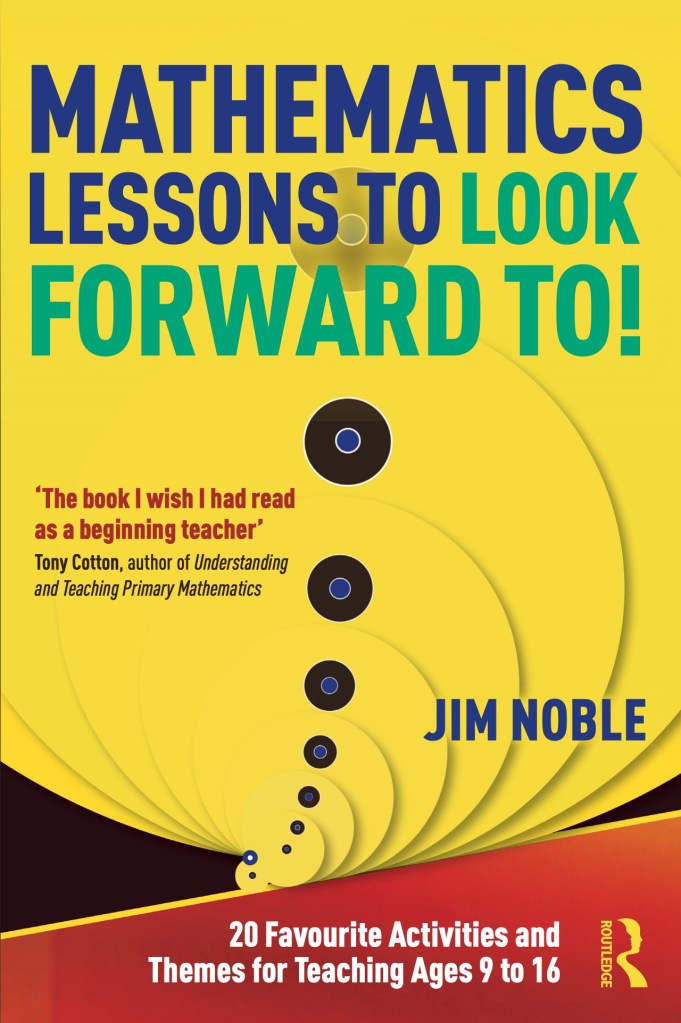
Jim Noble has written the book I wish I had read as a beginning teacher over 40years ago. He reminds us that it is okay to see teaching as a joy, as something that makes us want to get up in the morning. He also reminds us that sharing mathematics with young learners is at the heart of this joy. As I read the book, I enjoyed working on the mathematics that Jim shared, I valued hearing the personal contexts from which these activities and thus the lessons had arisen and most of all, I enjoyed thinking which learners I would most like to work on this mathematics with. I have agreed to work in my grandsons’ school next year.
Tony Cotton, Editor: Mathematics Teaching, July 2022
Jim Noble’s new book Mathematics Lessons to Look Forward To! fills a slot on the book shelf that, for me, has been empty until now. The premise is simple: just what it says on the cover. But this isn’t a photocopy-and-hand-out kind of book at all. The tone is conversational, informal. The mood is reflective, contemplative even. The lessons and their impact are things that Jim Noble has clearly trialled in many
forms (as a friend and colleague, I’ve been lucky enough to see some of them in real life!) and then regarded from many angles, sifting, pondering, tweaking. He wants us to examine them with us, and if we’re so inclined, for us to make them our own. He takes a philosophical turn too, looking at what the lessons have to say about distinctively mathematical ways of knowing. It’s great to see the joy and questioning approach that are the hallmark of his teaching come through on the page here. And, as a primary teacher, I find so much to think about in this book. In fact, many of the lessons could easily be adapted for primary classes of all ages.
Simon Gregg, International School of Toulouse, July 2022
Abstracts & Resources from the book
Originality & The Lost Bone
Right at the start of the book I share a story about this fabulous hand me down resource – The Lost bone.
Chapter 1 – Whats in the box?
We open with a great activity that explores key concepts of probability. At least as importantly, it offers an excellent opportunity for us to consider what we mean by evidence, how evidence can be different and how it therefore needs to be used differently. As such it becomes a great way for us to consider the very nature of mathematics with a simple and revealing activity. In addition, we introduce the value of experimental scenarios as a way to think about mathematics, evidence and different types of reasoning.
Chapter 2 – Cones
This chapter is about properties of cones and a ‘One question lesson’ that invites students to explore this wonderful shape by making it. The chapter explores many ways in which this task provokes students to behave mathematically, which sets this up as a running theme through the rest of the book. Then we get to variations of how the idea of physically building a shape is an important way of engaging with its properties and relationships.
I found this video I made many years ago about cones way before I thought about writing where I say ‘This is one of the things that gets me out of bed in the morning’
Chapter 3 – If the World was a Village of 100 People
Inspired by the wonderful book called ‘What if the world was a village of 100 people’ this is a chapter about perception, ratios, percentages and proportion and activities based on this book. These are activities that push our understanding while practising in the context of some profound statistics about our world. There is also a logic puzzle and this gives us the chance to explore the role of logic in mathematics and why it’s such an important feature of teaching, learning and doing mathematics.
In this chapter I make reference to the World Village Ratio problem. You can read about the project we did with the gapminder foundation on this ‘World Village’ page. The puzzle is about 3/4 of the way down the page under the heading ‘The Word Village Logic Puzzle’
Chapter 4 – Goodness Gracious Great Piles of Rice
This is all about trying to give some concrete meaning to numbers that are quite hard to understand in the abstract or without a visual aid to magnitude. Based on the fabulous travelling exhibition from Stan’s cafe called ‘Of all the people in all the world’ where a person is represented by a grain of rice, we get into lovely layers of estimation, shapes, comparison and juxtaposition. The chapter goes on to reflect on general issues with ‘infographics’ and the heavy reliance on good mathematical design or mathematical investigation!
Chapter 5 – How do I love thee, let me count the ways
This chapter explores a few activities as means of exploring the principle of asking ‘How many ways….’ and how that freedom invites a degree of ownership over a task and releases the speculative mathematician within who is encouraged to think about what they could do as opposed to what they are supposed to do . We also point towards the playful, creative nature of mathematics as a pursuit. These are then the elements that can be used in the design and use of other tasks.
See the Quarter the Cross Blog that inspired it all from David Butler here which includes the amazing image David agreed to let me use in the book. Here is the latest version of the data game – the 2025 Puzzle as it was last!
Chapter 6 – Number Searches
This chapter revolves around puzzles and tasks involving subdivided shapes and, in particular the concept of a ‘Number search’ arising from collaboration with primary colleagues. Such a simple activity that encompasses so many aspects of mathematical behaviour and is a delightful way to encourage and, more importantly, observe the different approaches there can be to similar problems. We will look at a simple example involving circles and demonstrate some of the many mathematical ideas that can arise, before showing how it can be used at different levels.
Number Searches on google photos from Simon Gregg
Chapter 7 – Human Loci
One of my top 5 moments of the year when students become the points that have to ‘obey the given rule’ as we explore the wonders of loci and construction. Something so powerful about getting out of our seats and ‘being the mathematics’ before translating that to pen and paper activities and then on to some great challenges and the joys of construction that make up Islamic Tile design.
Chapter 8 – Statistics Telling Stories
On the same theme as the human loci, but now in the context of statistics, this one focuses on giving real depth of understanding to stats and diagrams that help us address the human connection referred to in the famous quote about ‘One death is a tragedy and 1000 is a statistic’. More practical out of the seat activity that offers perspective on some important statistical ideas and how we use them to tell the story of the data.
A version of this activity is on my website for IB teachers and you can read more specifically on this page. The number sets are in the file below.
Chapter 9 – Match Point
While we are on statistical ideas, this activity asks us to think significantly about frequency distributions whilst extolling the virtues of the ‘matching activity’ as a way of inviting certain thought and reasoning processes in students.
Chapter 10 – Prime Pictures
Our number system is such a source of fascination and prime numbers appear to be the DNA of it all. This is such an important thing to understand that it takes some thought about how to help students engage with it. With the help of some lovely visuals, this can do just that! The focus here is on multiple representations of mathematical ideas through visualisation and how we might make activities based around them.
The Prime Pictures activity is freely available at this link (and in colour!)
Chapter 11 – Population Growth
Mathematical modelling is more prevalent than ever in the current climate and this activity is about getting students to think about its very nature and how it relates to other things that they know. In this example we look at some population growth data and explore the technique of ‘taking some information away’ as means of designing a task.
Referring back to this ‘World Village’ page from chapter 3 – the modelling population growth puzzle is just under the World Village Logic Puzzle
Chapter 12 – Starting from Scratch
This is the first of three chapters with a focus on technology. Seymour Papert’s ‘Mindstorms’ first published in 1980 is a seminal bit of thinking about the impact of teaching and learning of technological developments. Not so different from Papert’s original ideas, this is about how we might merely scratch the surface of ‘scratch’ to unleash some mindstorms in my classroom.
Chapter 13 – Indestructible Quadrilaterals
This is the second chapter to focus on technology, this task brings out some of the wonder of Dynamic Geometry. What is the actual DNA of a shape? What are the limits and possibilities? Can a trapezium also be a rectangle and does everyone agree? Precise definitions are crucial in mathematics but to what extent are they arbitrary? All these questions and more are addressed in this activity about creating dynamic mathematical objects and everything that it tells us about mathematics.
A version of the The Indestructible Quadrilaterals activity is available here at this link.
Chapter 14 – Dancing Quadratics
Here we talk about a class of problems I have called ‘animated questions’ where, based on an animated clip of a dynamic mathematical object, students are asked to ‘Reverse engineer’ the animation based on what they observe and then effectively program it for themselves. We will focus particularly on an example involving quadratic functions but again demonstrate how it can be pitched along a big range of levels.
You can see some of the animations discussed, including the dancing quadratics, here on this page about ‘Animated Questions’.
Chapter 15 – Hot Wheels
Any excuse to raid my son’s Hot Wheels car racing supplies and travel around the world with them to make distance time graphs explore them up at multiple levels including an introduction to calculus! This activity, and suggested variations, are nice examples of how students make the journey from concrete, to pictorial to abstraction and keep track of it. (pun fully intended!)
Chapter 16 – Maxbox
It’s such a classic problem about optimisation that can get us to so many wonderful bits of mathematics from simple volume right up to calculus. This problem could be used from primary school right through in different ways and even revisited as a result. We will look at ways in which students can engage with the problem and where the opportunities are to optimise as teachers. It also allows us to look at conceptual, mathematical bridges that link areas of mathematics. It’s a well known problem, but still worth thinking about the ways in which it can be used and lead students on a long mathematical journey that brings so many of the things we have done here together.
Chapter 17 – Dancing Vectors
Imagine a class of 16 year olds performing a dance routine to Donna Summer’s ‘Hot Stuff’. In a mathematics classroom. “Honest boss, this is really purposeful”. This chapter is about conceptual analogy based on my experience of teaching about displacement vectors in the context of dancing! True story. It starts us thinking about important parallels between mathematics and movement and how to help students take a step up to more sophisticated ideas.
If you are brave enough then you have everything you need in the book and some videos below! Good luck and have fun.
Chapter 18 – Pleasure at the Fairground
Here I want to look at a more elaborate, large-scale activity that I do every year and definitely comes under the heading of fun and games. The fairground is a perfect context for playing with experimental probability and can happen on all kinds of scales at any age. It also raises legitimate questions about efficiency and value of time which I’ll try to answer by writing about the wider benefits of letting our hair down a little as well as the value of experiences that we can feed off.
You can get some related resources for fairground games here on this page, which includes the video below….
Chapter 19 – Impossible Diagrams
Ok, so not as visually appealing as the wonderful work of MC Escher and others, but still a great way to explore and practice ideas. I can sketch anything I like in maths but that doesn’t mean it can exist in reality. These activities are about another way of looking at problems kind of in reverse and the associated reasoning that is required. This task encourages students to dig around their mathematical armoury and use it to make arguments.
Chapter 20 – Cubism
And finally. Experienced during my teacher training year, here is an activity I have used every year since that gets right to the heart of mathematical generalisation and proof but starts with a lovely playful element. A perfect mathematical recipe! In describing this activity I invite you to think about the potential and the value in mathematical classroom manipulatives.
 noblegoals